

Tree Roots Under Buildings: Causes, Prevention, and Guidelines
When we talk about tree roots and the living environment, their impact under buildings and root pressure are particularly important topics.
This often causes concerns and discussions between tree owners and building owners.
Or even damage cases. Later we will look at it in more detail.
Tree roots near buildings
Trees are essential to our environment and provide many ecosystem services. However, their roots can sometimes pose challenges to buildings, structures and underground infrastructure.
We hear stories of tree roots growing under houses. And damaging foundations. Yet, such problems do not occur with every tree or building. Why do roots penetrate one foundation? But not another?
In this article we will discuss in detail the factors affecting tree root growth under buildings. In addition, we provide practical tips to prevent damage. Both in the design and construction phase, as during the long term maintenance.
We conclude with an overview of guidelines and recommendations. So that you know which distances and measures are recommended by experts.
Related articles
Trees provide ecosystem services, and these are benefits
Planting large trees, benefits and aftercare
Preventing Root Damage to Trees. Understand the effects of root damage
Make a tree shelter plan before you start building
In this article about tree roots and building environments
Why do tree roots sometimes grow under foundations?
Explanation of the conditions under which roots penetrate under buildings. And why this happens in some foundations and not in others.
Causes and factors: in-depth overview of the causes. Such as soil type, tree species, foundation type, humidity and other relevant factors.
Damage prevention: concrete tips to prevent root damage. Both during the design and construction of structures and via long-term management of trees.
Guidelines from the construction industry and government: summary of recommendations from WTCB (Buildwise) and the Agency for Nature and Forests (ANB). Including reference to sources or downloads.
Conclusion: key lessons learned on how trees and buildings can coexist safely.
Causes of root growth under buildings
Tree roots generally grow where they have the best chance of getting water, oxygen and nutrients. Whether they grow under a building depends on a combination of factors.
Below we discuss the most important ones: soil and moisture conditions, tree species and root behaviour, foundation type en distance/space. Also some other factors are discussed. These aspects explain why roots remain problem-free in some foundations. While elsewhere they can cause nuisance.
Soil type and moisture conditions
The properties of the soil and the moisture level play a major role in root growth. Tree roots search for water and oxygen and prefer soils that offer this.
In normal circumstances water, oxygen and nutrients are mainly found in the upper soil layer. Rainwater mainly penetrates from above. And organic material accumulates at the top. And decomposition products from the organic material seep into the soil from above over the years. That is why most roots are in the upper soil layers.
Research shows that the vast majority of roots are located in the top 40 to 50 cm of soil. This top layer usually contains more moisture and air than deeper soil layers. Deep roots are usually physically difficult for a tree and not necessary.
The soil type and its condition determine how attractive the subsoil is for roots.
Tree roots and a sandy bottom
In a well-drained, sandy soil roots will easily grow horizontally and vertically. However, in dry sandy soil they stop as soon as there is no more moisture. For example, under a canopy where no rain falls. Roots do not grow in dried out or bone dry soil.
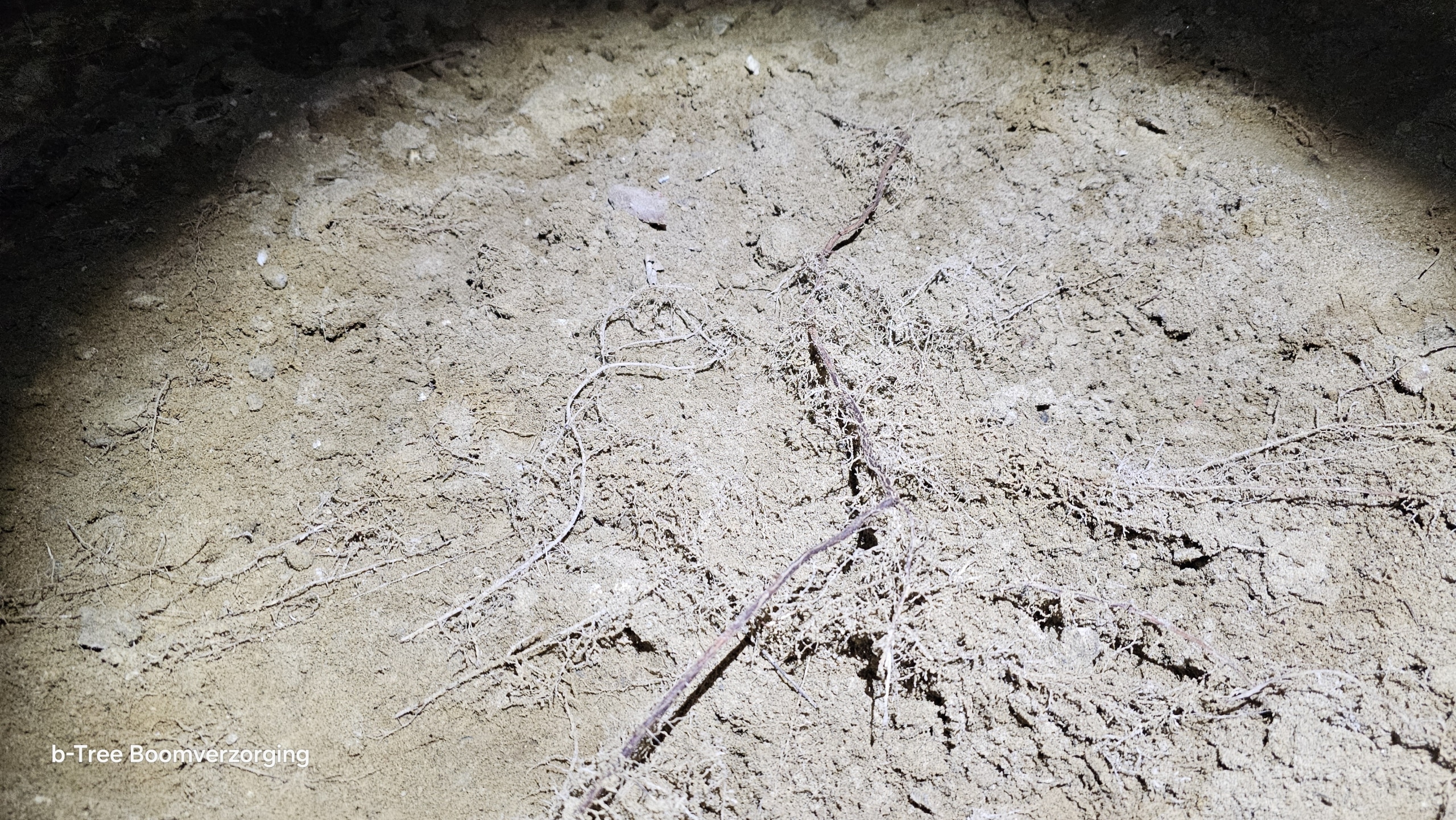
Even under a building, the soil often remains relatively dry (due to the roof) and low in oxygen. Which can limit root growth. However, if there is under or near the foundation moisture present is, the situation changes. A leaking pipe, damp basement or puddle formation can attract roots. Roots to notice as it were where there is water. And will grow through small cracks or along foundations to reach those sources. They will not break open an intact concrete foundation or masonry. But if there is a crack or opening and water (and nutrients) is available, roots can enter there.
Clay soil and tree roots
Clay soils form a separate story. Clay soil expands when it is moist and shrinks considerably when it dries out. Trees that grow in clay soil extract a lot of water from the soil in the summer. As a result, the clay dries out and shrinks even more. In the case of shallow foundations, this can lead to uneven settings lead. The building sinks more on the tree side, which can cause cracks.
Conversely, when such a tree is uprooted, the soil moisture slowly increases again. The clay then swells. And the building can push up. Sonly years later when the water shortage has been replenished.
The influence of a tree on the moisture balance of clay soil is surprisingly far reaching. Up to 1 to 1,5 times the tree height around and up to 5 meters deep. This means that a large tree can dry out the subsoil in a wide radius. In dry summers, the drying out can even penetrate deeper into the soil than the normal seasonal influences. Especially with thirsty species such as poplar or willow.
In summary: in shrinkage-sensitive soil, the presence of trees is a critical factor. A dry subsoil prevents roots. But drying out of clay by trees can destabilize foundations.
Soil moisture influences how and where tree roots grow
Humidity around the foundation is therefore crucial. For instance, a constantly moist area (from a broken storm drain, sewer or septic tank) will attract roots.
Poorly draining soil can also cause water to remain under a house. Roots (of some) trees then grow under the foundation to reach that water.
Conversely, a wide roof overhang that keeps the ground close to the facade dry can be a kind of root free zone awareness
In practice, one must ensure good water management. No leaks, good drainage and preferably let rainwater infiltrate into the garden further away from the house. The latter provides the tree with water at a safe distance. And discourages roots from seeking close to the foundation.
Tree species and root behaviour
Not all trees have the same root behavior. Some tree species are known for their rapid, progressive root growth. While others remain more modest.
As a rule, fast growers above ground are also fast growers below ground. For instance, poplars and willows grow quickly. And have extensive root systems that search for water. Oaks and ash trees can also cause damage above average due to their large water needs and extensive roots.
In an English study, oaks were found to represent only ~2% of the tree population. But were responsible for over 11% of root-related building damage.
Tree roots of fast growing species
Poplars, ash trees and Robinia (pseudo-acacia) also caused disproportionately much damage. In contrast, there were also species that were relatively few damage. For example, cherry and plum (Prunus) and rowan (Sorbus) were widely planted. But were rarely involved in damage cases.
This indicates that tree species choice matters. Although no tree excluded is of potential risk.
A major misconception is that a tree with a taproot goes deep into the ground. And thus forms a mirror image of the crown. In reality, a tree looks very different underground. Often as a wide, flat “wine glass” shape with scattered, shallow roots.
Where do most tree roots grow in soil?
Almost all tree species develop their root system mainly just below the surface. If conditions permit. Even species that are known as “deep rooting” will spread their roots mainly horizontally. If the soil at the top is well rootable and the deeper soil is poorly rootable.
However, there is variation. Some species (such as maples or pines) have many superficial roots. And cause root pressure under hard surfaces sooner. While others root somewhat deeper, if the penetration resistance of the soil allows this.
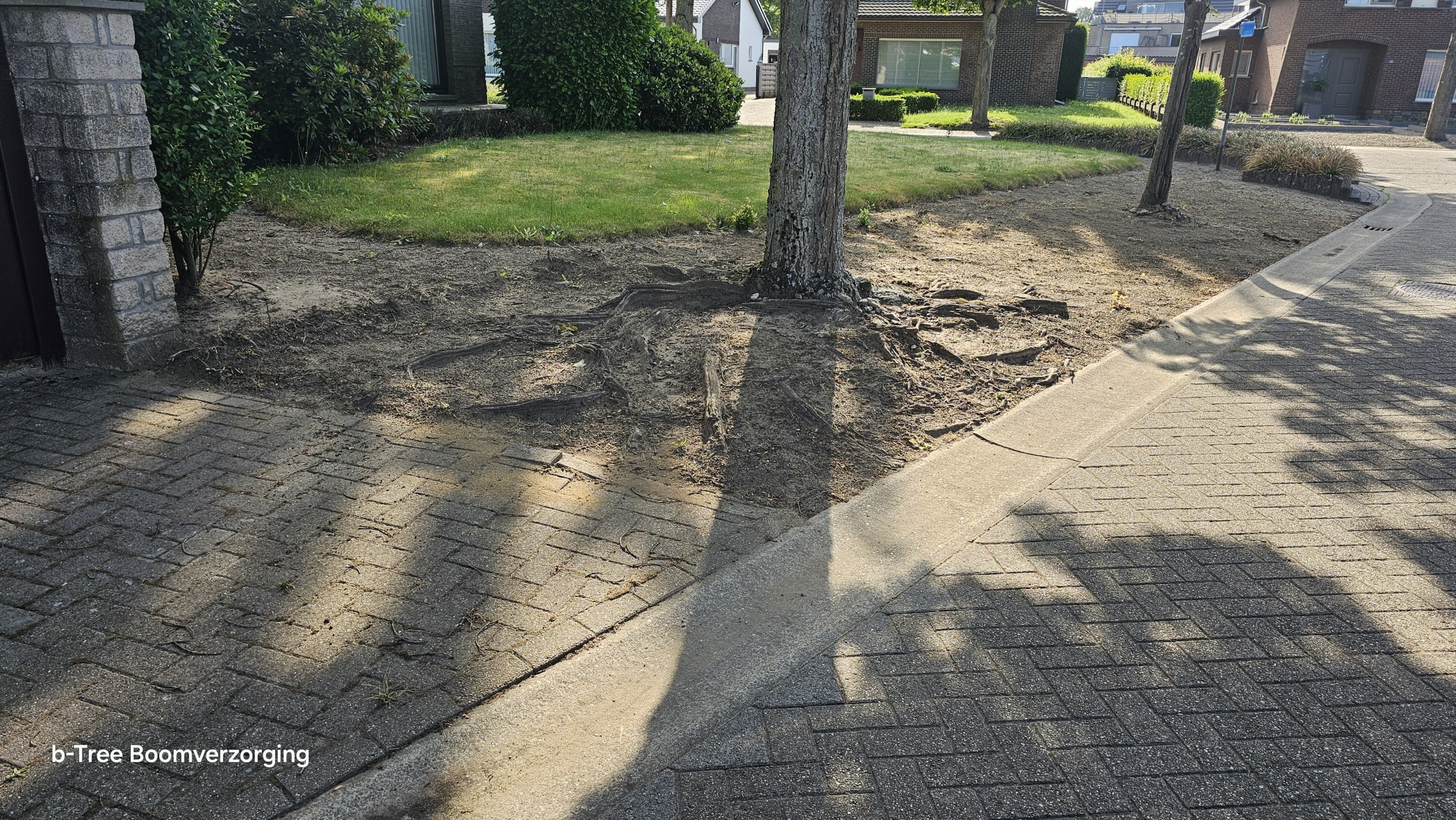
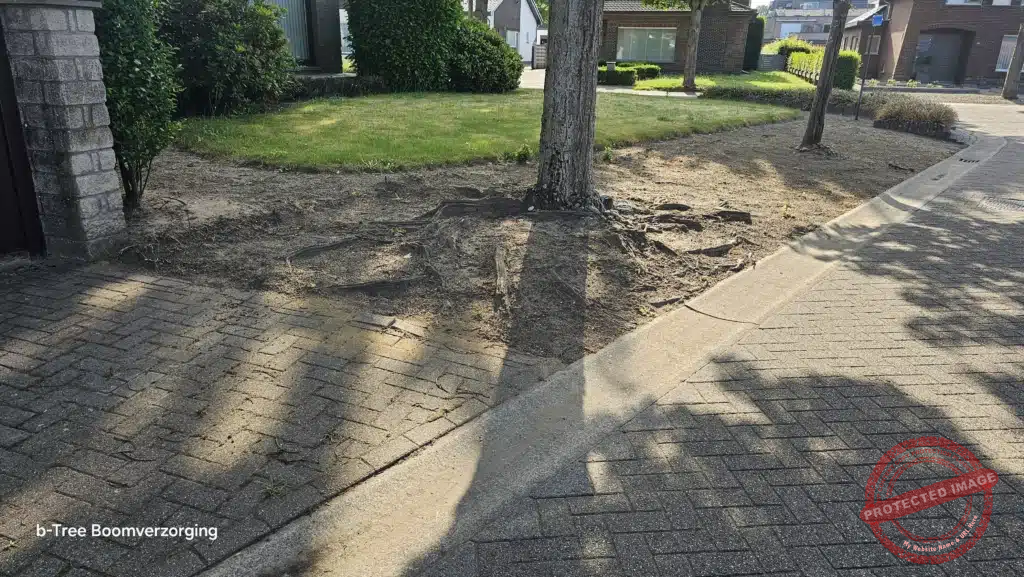
This Acer saccharinum gives root pressure around its trunk base because the soil where it is planted is very hard and therefore compacted. It is difficult for the tree to root deeply and it prefers to expand superficially.
However, all trees adapt to the available space. If the upper soil layer (top layer) is well rootable and the underlying soil is not, the root system remains shallow and wide. If the entire soil is very compact and/or dry, serious root pressure can occur and roots can become clearly visible above ground.
On the other hand, tree roots can be forced to search deeper for water. If the soil is still rootable. But really deep growth (more than 2 meters) rarely happens. Because the necessary oxygen and nutrition are then lacking.
Tree roots near buildings and foundations
Tree roots don't "seek" foundations, they seek water and nutrients. They prefer to grow around hard obstacles. Instead of through them. Therefore, tree roots will destroy an intact concrete foundation wall. don't push it to pieces or break through. After all, there is no food or water for the tree in concrete or new masonry. So the root has no advantage there and therefore nothing to look for.
What can happen is that roots grow along the foundation. On the border between the ground and the masonry. And possibly go through small cracks or openings if there moisture can be found. For example, an old brick crawl space with porous joints can become rooted if there is moist soil inside.
Thick tree roots can exert pressure and cause damage in residential areas
In addition, thick roots growing under or next to a shallow structure can, over time, cause mechanical damage busy exert. The root thickens annually. And can thus push against a concrete slab or brick wall. This usually happens with lighter structures (driveways, garden walls). But also with very shallow foundations of houses a strong root could eventually cause cracks by sheer force. Everything depends on the weight of the house or building.
In short, the tree species affects the chance of root growth under a building. Fast, large trees are riskier than small, slow-growing trees. Of course, no species is completely safe if the conditions are “favorable” for the tree. Which can mean “unfavorable” for the building. All trees need water, oxygen, nutrients and space. And any root system can then cause problems if the conditions for rooting are favorable. And the normal ground space is too limited.
The best approach is therefore mainly: plant the right tree in the right place. And give it enough room to grow. In the following paragraphs we look at the role of the foundation and the distance thereby.
Tree roots and foundations made of masonry with lime mortar
We would like to point out that old masonry with porous bricks and lime mortar is a different story. Then new masonry with closed joints.
Constructions with old masonry have very often cracked over the years. And the loose lime mortar releases useful elements for the trees. Including calcium and potassium. Which makes it attractive for tree roots to colonize this type of masonry. And once a root has grown through the wall, it can become thicker and possibly cause damage. Any damage will depend on the weight of the building. Either the root can become thicker. Or it is pinched by the weight of the building.
Type of foundation and building
The construction and depth of the foundation largely determine whether roots can get underneath it.
Modern buildings often have deep foundations. Deeper than 1 m below ground level or standing on underground piles. Which means that the lower part of the structure is well below the active root zone.
Tree roots grow mainly in the top half meter to meter of the soil. Where moisture, nutrients and oxygen are present. And where the soil is sufficiently permeable for the root cap. Which means that a root cannot grow in a hardened soil. Which has a penetration resistance of more than 2 to 3 MPa/cm².
And lower than the groundwater table there are hardly any roots anymore. Because at the place where the soil is saturated with water there is not enough oxygen anymore.
And from the moment a root hits a hardened layer, root growth will no longer be possible. The hardened layer can be created because of artificial compaction. Or because of a natural geological process. In which, for example, iron sandstone was formed.
If the base of the foundation is deeper than where most roots come from, there is little chance that roots will onder the building. They would then end up in very oxygen-poor soil, which they avoid.
And if roots of trees end up on the hard part of the ground, on which foundations rest, root growth will also no longer be possible because of the excessive penetration resistance. Many roots will then bend along the outside of the foundation wall. And grow underground past the building, without reaching the inside.
Shallow foundations and tree roots
At shallow foundations the risk is greater. Old houses or outbuildings may have foundations of only a few dozen centimeters deep. In such cases, foundations and roots are in the same zone. Roots can grow under a simple concrete slab or strip foundation if there is space and moisture.
For example, in a porch on a thin concrete slab, roots from a nearby tree can lift the base or cause cracks as they grow thicker. Also in houses without a basement that are founded less than 60 cm deep in clay soil, roots can dry out the soil under the foundation during dry periods, which can lead to subsidence.
The quality of the construction also plays a role. A well-constructed reinforced concrete foundation is strong and usually waterproof. Roots are more likely to go around it than through it. A masonry foundation or old foundation with cracks is more vulnerable. Tree roots can exploit small openings. Not around the foundation to invade out of aggression. But simply because there is space and often moisture. So you see that roots find a way into the crawl space via expansion joints or cracks. If there is moist soil inside.
Distance between the tree and the building
The design of the foundation in relation to the trees in the area is also important. The WTCB (Buildwise) recommends that foundations symmetrical and of equal depth everywhere to make. If one side of the building is founded on harder ground or deeper than the other side (where trees may be), this can cause uneven movement. Furthermore, for clay and loam soils, a foundation depth of at least 1,5 m to maintain. At that depth, seasonal fluctuations in soil moisture are minimal. And tree roots normally no longer come. Moreover, 1,5 m deep is approximately equal to the frost-free depth and below most root growth. Which offers double certainty.
Building type and its weight
Finally, it plays building type and its weight with. A heavy construction on a solid foundation will not be moved quickly by roots. Often a root will bend or die sooner than lifting an entire house. A light construction (such as a wooden garden shed or an old brick garden wall) on the other hand is more sensitive. Strong roots can deform it more easily.
In addition, roots can cause indirect damage to buildings via adjacent infrastructure. For example, a tree root that pushes an old sewer pipe can cause a leak and flushing of soil, causing the subsoil of the foundation to sink. Such indirect effects are difficult to recognize as root damage, but are part of the risks.
Distance between tree and building
Distance is one of the most practical factors. The closer a tree is to a building, the more likely its roots are to come into conflict with it. Simply put: a tree 1 meter from your facade will almost certainly have roots near the foundation. While a tree 20 meters away will probably have no effect at all.
But how far is safe enough?
A well-known rule of thumb, also cited by the WTCB (Buildwise), is to maintain a distance of at least 1 to 1,5 times the mature tree height to respect between a large tree and a building. For instance: for a tree that grows to about 10 meters tall, ideally plant it 10 to 15 meters from the house. This may seem like a lot, but take into account the extensive root zone and the influence on the soil.
Research confirms that tree roots can reach very far. Often 2 to 3 times the diameter of the crown or even more. In exceptional cases, roots of trees have been found more than 30 m from the trunk. As we found roots of an Acer saccharinum in Sint-Katelijne-Waver, which were more than 30 meters away. To consume moisture and nutrients (humus-rich litter layer in the borer) in the border (next to the lawn).
In Belgium, there are also legal regulations for distances. Although mainly in the Civil Code. For the distance to the tree and the plot boundary. Usually 2 m for higher planting. These rules serve to prevent disputes between neighbours. And do not necessarily overlap with the technical distance that is required to avoid foundation damage.
Technically, the recommendation of 1 to 1,5 times the tree height is a safe margin. In practice, such a wide distance is not always feasible in gardens or streets. That is why it is all the more important to use a limited distance additional measures to take (see further under prevention). Think of providing sufficient rootable space in the right place. The right choice of tree species per location. And root barriers and adapted foundations.
The rootable space strongly influences root growth in trees
Also the space around the tree plays a role. If a tree is directly bordered by a building on one side and has open space on the other side, most of the roots will grow into the open space with loose soil (if there is water and nutrients). This is beneficial for the building.
However, in a narrow city garden with a lot of paving around, the tree can't go in many directions. Roots will use every crack in the soil. Sometimes you see that roots go right under sidewalks or foundations. Because there is still loose soil there (under roads and buildings the soil is often disturbed during construction but not completely compacted).
In addition, placing trees asymmetrically in relation to a building can lead to differential setting lead. If all the trees are on one side, that side of the building can be affected a little more after a few years. This is especially relevant with clay soil and shallow foundations. Therefore, it is better, if possible, to spread trees a little further around. Or to keep the building at a sufficient distance from trees.
Other relevant factors
In addition to the main points above, there are a few other factors that determine whether roots cause problems:
- History of the location: Has a large tree recently been cut down on the site where a building now stands? Then the soil may still be “in recovery”. As mentioned earlier, removing trees on clay soils can lead to after swelling lead. Which only has an effect years later. New buildings on former park and forest plots must take this into account. A thorough soil investigation before construction starts can estimate this risk.
- Age and growth of the tree: young trees still form thin roots that have little strength. Problems usually only arise when the tree is larger. And forms thick roots. Many cases of damage occur 10, 20 or 30 years after construction. When initially small planted trees grow. And their roots begin to affect a larger volume of soil. It takes time for a tree to reach the size that causes noticeable drying or pressure.
- Presence of barriers or screens: In some cases, root barriers were placed during construction. Or foundations were extended with so-called "tree aprons". These are concrete slabs or foil that slope away from the foundation. Such measures can force roots to to go deeper. Or bend. Away from the building. The effectiveness depends on the depth and the material. A screen that is only 30 cm deep is of little use. Roots will go under it. But better root barriers can be placed up to 1,5 m deep for better effect. Note that root screens must be installed correctly to be effective. Otherwise, roots will come along (or under) and grow back up the other side.
- Condition of sewerage and pipes: Tree roots like to grow in moist, nutrient-rich environments. A leaking sewer pipe or water pipe under or next to a building is a magnet for roots. They can enter the pipe through a small crack. And eventually clog it or pry it open further. This can also indirectly wash away or saturate the soil under the foundation. Which affects the stability. A well-placed and maintained, leak-free sewer system around a building is therefore important in preventing these types of root problems.
- Tree maintenance: Trees that are pruned regularly often have a more limited root system than freely growing trees. There is a balance between crown and roots. Less foliage can support less root growth. The periodic pruning of a tree can therefore reduce root activity and water absorption to a certain extent. However, this depends on the species: some species respond to pruning with extra strong regrowth. Inexpert pruning can also weaken the tree or introduce disease. As a measure against root damage, pruning is therefore not a miracle solution. But in certain cases, for example when pollarding willows, it keeps the tree small. And the root development proportional.
We have now seen under what circumstances roots can grow under buildings and cause damage. In the next part we will discuss how we can prevent or limit this. Both in the design phase of new planting and constructions. If via long term management of existing trees.
Prevention en solutions for tree root damage
Prevention is better than cure. Fortunately, there are numerous measures to prevent or limit damage by tree roots. These measures ideally start with the design of the garden and the foundation. But there are also management solutions for existing situations. We divide the recommendations into measures in the design and construction. And measures for the long term management.
In design and construction (planning & construction)
When you can plan ahead, you have the most options to avoid problems. Some important points to consider:
- Involve us timely as tree technical advisor. Together with a structural engineer, this at the very beginning of the design phase. Even before the actual building design. This is useful for designing near existing trees for proper tree protection. Also useful for preventing damage to and by tree roots. This approach also applies to the design of the landscaping.
- Choose the right tree for the right place. Do not plant a large, fast-growing tree right next to a building. Keep a good distance. Bpreferably at least 1 to 1,5 times the expected tree heightIn a small city garden this means that you better choose a smaller tree species. That can be placed a few meters away. Please inquire with us to the suitable tree species and the adult size of the tree and adjust your choice accordingly.
- Provide sufficient rooting space. Trees with limited underground space will look for expansions. Often by causing root pressure and expansion towards foundations or pipes. Therefore, provide sufficient open space for new plantings. And sufficiently large planting areas away from the house. In which the tree roots can develop. For example: create a tree bed of good topsoil. At a sufficient distance from the house. So that the tree can find water and nutrients there. And is less inclined to search under the house.
- Carry out a soil and root survey for new construction in a wooded area. This is especially true on clay and loam soils. The WTCB (Buildwise) recommends conducting a simple geotechnical study (cone penetration test) for every construction project. Additional research is also recommended if shrinkage-prone clay is encountered. This allows you to assess the soil's susceptibility to drying out due to trees. Adjust your foundation design accordingly. Or take precautions, such as deeper foundations. Information about former trees on the site is also useful. If there were recently large trees that are now gone, inform your engineer or architect. They can then account for potential ground swelling in the coming years.
- Adapt the foundation type to the situation. If you are using must building near existing large trees, let us first root research perform. So that you can choose the right foundation method that minimizes root influence.Strip foundations or foundation on steel (this is a foundation with a widened flat foot) must be placed in clay at least 1,5 m deep. If that is not possible, consider pit foundations or piles. Which transfer the load deeper to a stable layer. Pile foundations usually go under the root zone. And are insensitive to superficial shrinkage or root pressure. Coordinate this with a structural engineer. Sometimes it is sufficient to make the foundation beams locally deeper on the side of the tree.
- Keep foundations uniform and avoid asymmetry. Lay the foundation of the building at approximately the same depth everywhere. This prevents one side (near the trees) from being more vulnerable. When adding on or extending, try to take existing foundation depths into account. This prevents uneven settlement.
- Install root barrier measures if necessary. In cases where the distance is insufficient, you can incorporate technical solutions: for example, a root screen between the tree and the foundation. This is a physical vertical barrier (made of special plastic or a concrete wall) that prevents root growth or forces it deeper. Have the screen installed deep enough to below the groundwater table if necessary, for proper functioning. This depth will also depend on the results of the root researchA root barrier is ideally installed during construction, along the foundation trench or around the tree's root zone. Besides screens, other solutions exist, such as: underground growth site constructions; for example sandwich constructions of tree bunkersA sandwich construction is a structure of paving layers with a horizontally placed pressure-spreading crate system that discourages roots from causing uplift under driveways, while still ensuring the soil underneath remains permeable to roots. A tree bunker is an underground structure primarily used to provide space for tree roots in combination with the protection of nearby infrastructure. These are applied more often at roads than at houses, but the principle – ensuring that tree roots receive their own allocated space – remains the same.
- Choose a suitable tree species. Although species selection is not a guarantee, you can risk species Avoid close to buildings. Poplars, willows, summer oaks, maples, plane trees, etc., are known for their vigorous root growth and water consumption – it's best to plant them well away from them (or not at all in a small garden). It's better to choose trees that stay smaller or are known to have less pronounced root growth, especially towards structures. For instanceA small ornamental apple, rowan, or Japanese maple may be more suitable near a home than a plane tree. Ask us or consult existing literature (such as the lists in some research reports) regarding which trees are relatively “safe.” Remember, however: even a small tree has roots that can reach far, so do not overestimate the choice of a suitable tree species.
- Use well-thought-out planting plans. You can be creative in a design: plant tall trees further away and use lower shrubs or ground covers closer to the house to still have greenery near the house. You can also reduce tree spacing through interventions: e.g. planting the tree on the other side of a driveway (the driveway then acts as a partial barrier) or ensuring that rainwater infiltrates mainly on the tree side of the garden, so that the tree “knows” where the water is and roots in that direction.
- Have a water management plan in place. Prevent your construction project from unintentionally creating dry or wet zones that repel or attract trees. Guide rainwater away from the foundation via infiltration crates or wadis, so that roots also stay away from the building and no excessive moisture develops close to the foundation. And always consider whether the soil consists mainly of a sand fraction or clay fraction.
Long-term management (maintenance & interventions)
If there are already trees near your building, or after you have planted new ones, sensible management is essential. Some long-term tips:
- Inspect regularly for early warning signs. Pay attention to changes in your building and surroundings. Cracks in walls or floors, jammed doors and windows, or subsidence in the terrace can indicate uneven settlement. Curving or cracking in the pavement or terrace outside can also indicate root pressure. Early detection allows you to intervene in time (for example by advice from our tree technical advisor and consult a structural engineer) before the damage becomes serious.
- Keep surrounding infrastructure intact. Make sure that sewers, drains and water pipes in and around your home are in good condition. Have them checked periodically for leaks, especially if there are large roots nearby. A small leak can attract roots and grow into a major problemBy keeping pipes watertight, you deprive roots of an important stimulus to grow towards your foundation.
- Water in the right place (and in moderation). In dry summers, clay soil can shrink considerably due to trees. Although it sounds contradictory to previous advice to keep the foundation dry, in some cases it can be useful to to irrigate garden further away from the house during extreme drought. This is how you prevent the tree roots from too many water from the ground beneath your foundation without wetting the ground right up against the foundation. However, give no excess water right next to the foundation, otherwise you create a magnet. It's a question of balance: keep the general soil moisture at the right level, but avoid wet spots right by the house.
- Perform tree care sensibly. If you suspect that a tree is growing too large or is rooted too close to the foundation, contact our tree expert in. Who can see if root pruning together with other measures are an option. Targeted root pruning (for example by digging a trench using air-spade technique at a certain distance and pruning roots there, together with a root barrier) can stop further growth towards the house. This must be done very carefully: pruning large roots too close to the trunk can cause irreversible damage to the tree and even mechanically destabilize it. In addition, some trees react excessively to root pruning by making extra roots. So always have this done by professionals and only with a certain percentage of root loss at once, so that the tree can recover.
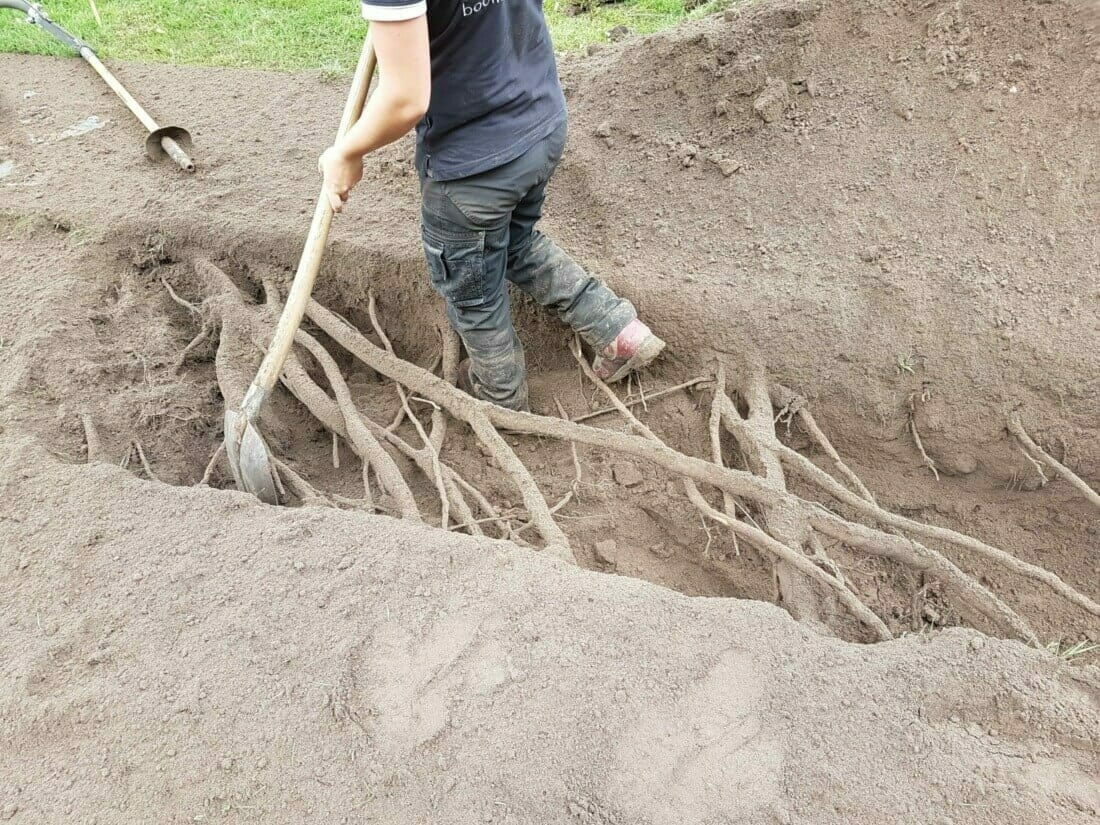
Arborist at work with an air spade during a root survey of a large Acer Saccharinum.
- Prune the crown if appropriate. By keeping the tree crown smaller (for example by periodically pruning or re-pollarding pollarded trees) you temporarily reduce the tree's water requirement, which can reduce root activity. This is no permanent solution, because many trees regrow their crowns. Some species, such as poplar and willow, even grow back vigorously after pruning. However, maintenance pruning every five years can prevent the tree from growing uncontrollably large. Consult with us as your arborist for a suitable pruning cycle that won't harm the tree's health. We adhere to the guidelines of the European Tree Pruning Standard for pruning trees.
- Remove problem trees promptly, but with care. In extreme cases it may be better to cut down a tree if it poses too much of a risk to the house. Preferably do this not all at once if the tree is very large and in clay soil, without further measures. Sudden removal can, as discussed, lead to soil infiltration (the soil absorbs moisture and expands). The WTCB (Buildwise) warns that damage due to swelling often only becomes visible years after felling. One strategy could be to remove the tree gradually (e.g. first prune it heavily, leave it for a few years with less crown, then finally cut it down) so that the water balance gradually normalises. Or you can cover or drain the soil for a while after felling to prevent extreme moisture. This is very situation-dependent; ask a geotechnical expert for advice if you have any doubts.
- Repair and strengthen foundations as necessary. If damage does occur despite everything, it is sometimes unavoidable to intervene structurally. Stabilization of the building can be achieved by to address the cause and / or by the to improve foundation. Underpinning (placing additional foundation elements that reach deeper) can support a subsided building again. This is expensive and drastic, so it is better to prevent it from getting that far by taking the preventive measures mentioned above. However, it is good to know that there are solutions: few cases are really hopeless.
In summary, good care and alertness are key. In addition, it helps not to see trees and buildings as enemies, but as elements that can go together very well with the right approach. With good design, regular maintenance, monitoring and interventions if necessary, trees can grow old without harming your home.
Guidelines and recommendations on challenges between tree roots and infrastructure
Both building authorities and green management organisations in Belgium have drawn up guidelines to avoid conflicts between tree roots and buildings. Below is a brief overview of some important sources and their recommendations.
WTCB (Buildwise) – construction guidelines
The Scientific and Technical Centre for the Construction Industry (WTCB), recently renamed Buildwise, has warned in various publications about the influence of trees on foundations, especially in clay-rich areas. In WTCB Contact No. 3/2018 the risks and precautions were clearly summarized. Some key points from these guidelines are:
- Zone of influence of trees: the influence of a tree on the moisture content of the soil extends to a distance of about 1 to 1,5 times the tree height and until 5 meters deepThis underlines that even trees several metres away can have an effect, especially in sensitive clay soil.
- Minimum distance and foundation depth: the WTCB recommends providing sufficient distance between the tree and the building, at least 1 to 1,5 times the mature tree heightIf this distance is not achieved, it is advisable to deepen the foundation further or to use a different type of foundation (e.g. pile foundations). In very shrinkage-sensitive soils (high plasticity index), WTCB recommends to always deepen the foundation to a minimum 1,5 m depth to be founded on steel foundations (foundation with widened base).
- Design and research: for every project involving trees: perform a thorough soil and root research. If there are clay layers in which the foundation will be laid, have them analysed for sensitivity to shrinkage and swelling. Also check whether trees on the site have recently been felled, as this affects the soil conditions. Try to set the foundations evenly (at the same depth everywhere) to prevent differential settlement.
- Intervene in case of damage: The WTCB (Buildwise) suggests that if a building does sustain damage due to soil volume changes, the cause should first be addressed and, if necessary, the foundation should be stabilized. Addressing the cause may involve pruning trees in winter to kill off some of the roots (although this only has a temporary effect on some species), or, in extreme cases, removing the problematic tree. Stabilization may require deepening the foundation to a more stable soil layer (e.g., by underlaying/filling or adding posts). Note that removing a tree also damages its ecosystem services that it provides disappear, which also has negative effects for local residents. We always recommend first doing a very thorough study of which tree-technical and construction measures are possible to preserve the tree completely and future-oriented and still solve the problem of root damage, before cutting down a tree. Because cutting down a tree often also brings with it technical complications. And its ecosystem services disappear.
These recommendations from WTCB (Buildwise) are intended to be used already in the design phase to take trees into account. They can be found in the WTCB Journal and Contact details. Buildwise offers this information via their website (the Contact publications are freely available). In short, the construction sector officially recognizes the importance of tree impact: building a house near large trees requires extra attention and precaution.
Agency for Nature and Forests – green management guidelines
The program Agency for Nature and Forests (ANB) of the Flemish government has also issued technical guidelines in the context of harmonious park and green management. Relevant, for example, is the “Technical Vademecum Paths and Pavements” (ANB, 2011). Although this handbook focuses on paths and paving in public green spaces, it contains principles that can also be applied to buildings:
- Distance and space remain the starting point: the vademecum emphasizes that one should do as much as possible distance must be provided between trees and infrastructure to prevent root problems. If sufficient space is not available, technical solutions must be used, whether or not expensive, such as root screens, sandwich constructions or tree bunkers.
- Tree species alone is not a miracle cure: The document debunks the “myth” that choosing a different tree species will solve all root pressure. Some species root more superficially than others, but ultimately each tree adapts its root system to the available space. So you can't just plant a "non-invasive" tree and do nothing else; it too can cause damage due to lack of space. This is another argument in favor sufficient rootable soil and, if necessary, technical measures when the situation is tight.
- Use of materials and constructions: ANB recommends making pavements water and air permeable where possible. This is not only environmentally friendly, but also tree-friendly and climate-friendly (through stormwater harvesting, among other things): it ensures that rainwater can penetrate the soil on site, which encourages tree roots to stay under the path (where the water is) instead of looking for moisture above or elsewhere. This is less applicable to buildings specifically, but around houses (on driveways, terraces) it can help to use breathable materials that keep the tree roots in the subsoil.
- Documentation and tools: The Technical Vademecum and other publications (e.g. on tree growing sites) can be downloaded free of charge from the Vlaanderen.be website. They offer managers and designers insight into how trees can be strategically incorporated without damage. Although housing is not the main focus, the same natural principles apply: give the tree the best growing place and it will leave your infrastructure alone.
Other resources and recommendations
In addition to WTCB and ANB, there are other agencies and sources that provide useful information:
- Municipal guidelines: Many cities and municipalities have tree regulations or policy plans. These often contain provisions on minimum planting distances for new projects, or how to deal with existing trees during construction work (e.g. preliminary drafting of a Tree Effect Analysis and carrying out the effective tree protection plan). Check with your municipality to see if there are specific recommendations if you are building or planting near trees.
- Knowledge platforms and study services: Organisations such as universities, academic institutions, Bos+ and Bomen Beter Beheren sometimes publish studies, guidelines or fact sheets. An example: the Belgian Grouping for Soil Mechanics and Geotechnics (BGGG) has published workshops and proceedings on damage to foundations on clay soil due to drought and trees. Such publications (aimed at professionals) confirm the need for adapted foundation techniques and offer case studies from Belgium.
- Professional organizationsFor arborists and engineering firms, there are methodologies and guidelines such as the Tree Impact Analysis, the tree protection plan, and the standards of the EAC (European Arboricultural Council) regarding tree protection, tree pruning, tree planting, etc. They help to evaluate in advance, on the one hand, the impact of desired construction plans and infrastructure works on the environment and existing trees, and vice versa.
- Legislation: As mentioned, the Civil Code regulates distances to plot boundaries. In addition, government projects often have to follow the principles of sustainable use of greenery be followed (think of the Flemish policy regarding Circular Green Management). This includes preserving and protecting valuable trees in construction projects, with measures such as demarcating root zones and avoiding soil compaction. Although this differs from roots under existing buildings, it is worth noting that prevention already starts with the maintaining a healthy tree structure in the city. A healthy tree with enough space will be less likely to show 'undesirable behaviour' such as root infiltration in search of water or root pressure.
In summary, Belgian guidelines advise to taking trees into account from the outset in construction plans. Respect generous distances or adjust the construction method so that the tree and the building do not get in each other's way. Both major players – the construction sector (WTCB/Buildwise) and the green management world (ANB) – insist on the same principle: well-considered planning will save you a lot of headaches later.
(Tip: the WTCB Contact publication of March 2018 can be found online at Buildwise.be for those who want to read the precise details. The Technical Vademecum Paths and Pavements can be downloaded from the website of the Agency for Nature and Forests.)
Foreseeability and liability
When root growth leads to damage to buildings, the so-called foreseeable, predictable and avoidable principle a central role in the assessment of responsibility.
In short, this means: could one have known in advance that damage was possible (foreseeable), could one have estimated the consequences based on professional knowledge (predictable), and were there reasonable measures to prevent the problem (avoidable)?
If all these conditions are met, it can be stated that the damage was to be avoidedIn that case, it is quite possible that an owner or manager will be held liable for negligence. That is why it is essential to always take these three elements into account when designing, planting and managing trees near buildings.
Ready to see how Snowflake works?
Tree roots and buildings don't have to be enemies, provided we understand their interaction and handle it intelligently. Problems arise mainly with shallow foundations, the wrong tree in the wrong place, design errors or careless management.
In this article we saw that tree roots usually superficial and broad grow, looking for water and oxygen – not purposefully for your foundation. Whether they grow under a building depends on factors such as soil type, moisture and distance. In clay soil, trees can cause indirect damage by drying out and swelling the soil, while in other soils physical root pressure or growth through cracks can play a role.
Fortunately, there is a lot you can do.
Prevention starts with planning: keep sufficient distance, choose your tree species carefully and do not force large trees into small corners next to a house.
Constructional technical You can eliminate a large part of the risk with deep foundations, root barriers and well-considered drainage.
Next is good tree management indispensable: regular inspection, maintenance (such as pruning) and intervention before small problems become big. Official Belgian guidelines from both Buildwise (WTCB) and ANB support this approach – they recommend good design, distance, research and if necessary technical measures to allow tree roots and buildings to coexist peacefully.
In short, with the right knowledge and precautions, one can fully enjoy both sturdy structures and lush trees. A beautiful tree near your home does not have to be a nightmare.
On the contrary, it can provide shade and value while leaving your foundation intact.
The key is: Think ahead and manage appropriatelyThis way, tree roots grow where we want them – deep in the ground at a safe distance – and your building remains firmly in place without being disturbed.


